
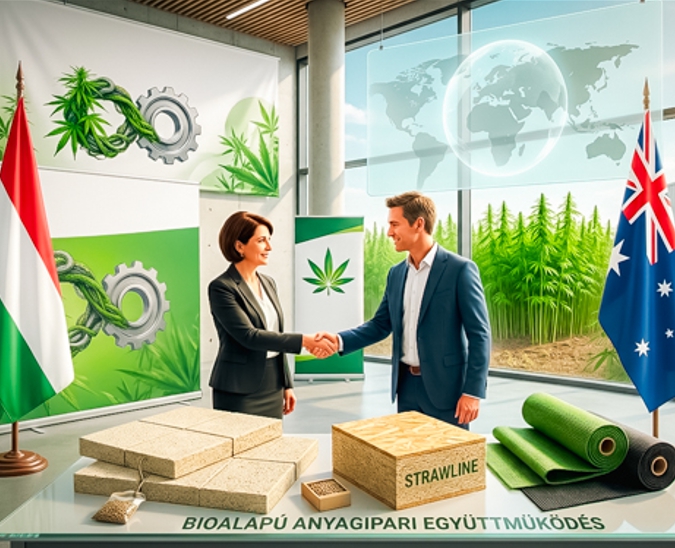
The organizers welcome additional domestic and international professional, industrial, and agribusiness partners to join the emerging partnership and international initiative in the future. The initiative aims to prepare an institutionalized, project-based collaboration that opens new markets for domestic players in the fields of sustainable building materials, biocomposites, green public procurement, and agricultural R&D.
Based on its published Federal Senate report, Australia's AIHA focuses on three main operational priorities: prioritizing industrial hemp products in federal green public procurement, resolving regulatory THC threshold limits based on scientific evidence ( THC), and clarifying hemp-based animal feeding procedures.
In parallel, the Hungarian side’s "Hungarian Industrial Fiber and Bio-Based Material Ecosystem" (Hungarian Industrial Fiber and Bioeconomy Program 2035) aims to establish a complete, integrated value chain—from seed production and cultivation to fiber processing, technical textiles, and hempcrete building materials, up to high-value-added automotive biocomposites and R&D innovations.
Building on the synergies of both initiatives, the parties are not preparing a generic memorandum of understanding, but rather an operational cooperation organized around 2–3 concrete demonstration projects. Under this framework, several key workstreams will be launched during a 90-day inception phase:
- Sustainable Building Materials & Procurement Demonstrator Project: Reference applications of hempcrete, thermal insulation, and bio-panel materials will be implemented in public building construction or regional development projects, accompanied by comparative Life Cycle Assessment (LCA) and model procurement documentation.
- Industrial Biocomposites Workstream: Focuses on the joint prototype development and industrial customer validation of automotive, acoustic, and architectural biocomposite components.
- Regulatory & Cultivar Testing Knowledge Exchange: Encompasses a review of Australian regulatory and public procurement experiences alongside the preparation of dual-climate adaptive cultivar trials leveraging Hungarian seed and genetic expertise
The long-term objective of the program is the re-industrialization of the Carpathian Basin's industrial fiber economy, rural job creation, and the reduction of import dependency. In addition to integrating domestic SMEs and research institutions, the initiative opens connection points for international and domestic industrial players, such as construction, automotive, and agricultural enterprises involved in demonstration projects and research.
During the preparatory phase, project funding is planned from internal and institutional resources, while subsequent implementation will rely on targeted Hungarian (NKFIH, GINOP Plusz, KAP, Jedlik Ányos Program) and European Union (Horizon Europe, LIFE, Circular Bio-based Europe JU, Innovation Fund) R&D and demonstration funding frameworks.
In the longer term, this initiative could also serve as the foundation for an international joint venture that combines the expertise, industry connections, and project development capabilities of Australian and European partners to support their joint presence in the global markets of the bio-based economy.