
Hungarian-Uzbek economic, industrial, and scientific-technical cooperation is deepening, underpinned by the strategic agreement between the ArchEnerg-Metál Cluster and the Surhandarya region of Uzbekistan. This partnership is not a simple declaration of intent, but a concrete, long-term cooperation plan aimed at developing mutually beneficial economic relations, primarily in the key areas of renewable energy and construction.
The agreement was officially signed at the Csongrád-Csanád County Government Office by Mr. Sherali Juraev, Deputy Governor of the Surhandarya Region, and Prof. Dr. István Bíró, President of the ArchEnerg Cluster, who thereby committed themselves to the preparation and full implementation of joint tender projects.
The focus areas of the partnership are crucial for the sustainable development and economic growth of both countries, where Hungarian innovative knowledge represents significant added value:
• Renewable energy: Projects aimed at utilizing solar and geothermal energy, including solar panel/solar collector systems and heat pumps.
• Construction industry: Modern construction and engineering solutions, such as the installation of prefabricated and passive houses.
• Environmental protection: Biomass recycling and compact biomass production, in line with the principles and practical requirements of the circular economy.
In addition, the ArchEnerg Cluster undertook to provide professional assistance, organize education and training opportunities, present innovative Hungarian technologies, and implement joint pilot projects, actively supporting Uzbekistan's economic and technological development. This strategic foundation provided the framework for the next step: a large-scale delegation visit that could turn words into concrete actions.
Strategy Turns into Action: The 11-Day Uzbek Innovation Visit
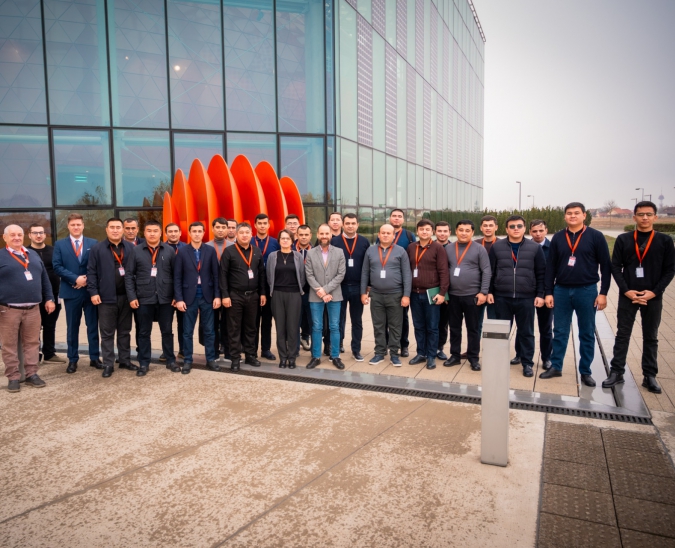
In order to deepen the strategic partnership, a 23-member high-ranking Uzbek delegation visited Hungary, organized by the ArchEnerg–Metál Cluster. The eleven-day thematic program (November 25–December 5, 2025) provided a comprehensive overview of the Hungarian innovation ecosystem from Budapest to Szeged, Karcag, and Szolnok. The main purpose of the visit was to explore specific opportunities for cooperation and to share Hungarian technological know-how.
To the sincere regret of the organizers and Chief of Protocol Dr. István Somfai, due to an unexpected change in the delegation's planned arrival, our guests were unable to see the architectural wonders of the Hungarian Parliament with a guided tour, nor enjoy a personal welcome from István Jakab, Vice-President of the Parliament, which would have made the start of the program a ceremonial occasion for them.
Highlights and Results of the Visit
The program began with the establishment of governmental and scientific relations in Budapest:
• Scientific Partnership: A major milestone was the visit to Óbuda University (ÓE), where the university committed to participating in the creation and operation of Uzbekistan's first innovation science park, Inno-Technopark. In addition, the delegation learned about the latest sustainable energy solutions from HUN-REN TTK and the Hungarian Hydrogen Technology Association.
• Applied Research: Bay Zoltán Applied Research Nonprofit Ltd. presented its industrial and agricultural waste utilization solutions (Bay Agri and Bay Waste) were presented at Bay Zoltán Applied Research Non-Profit Ltd.
The focus of the visit shifted to the cluster's center, the innovation region of southeastern Hungary, Szeged and its surroundings:
• Scientific Infrastructure: The delegation visited the ELI-ALPS Laser Research Institute, one of Europe's most modern scientific facilities.
• Regional Cooperation: At a reception hosted by the Csongrád-Csanád County Council, the delegation was given an overview of the county's economic potential, strengthening regional ties.
• Specific Technological Solutions: In Makó, they were shown the construction innovations of Bodrogi Bau Kft. (modern construction technologies, passive house solutions), and in Szarvas, they were shown modern aquaculture fish farming solutions and species research.
The presentation of industrial capacities continued in Szolnok and Karcag, including a tour of Jász-Plasztik Zrt.'s battery manufacturing and waste recycling systems.
Summary and Vision for the Future
The visit ended with a closing event at the National Innovation Agency (NIÜ), where a new cooperation agreement was signed.
The main results of the 11-day program:
1. Specific Project Opportunities: Participants gained in-depth insight into innovative Hungarian solutions in the fields of renewable energy, modern construction technologies, waste recycling, and agriculture (e.g., passive houses, waste management).
2. Deepening Scientific Partnership: Cooperation between Óbuda University and Uzbek institutions was strengthened in connection with the creation of an innovation science park.
3. Strengthening Strategic Relations: High-level government and regional receptions signal a serious commitment to the projects.
The wide-ranging program led by the ArchEnerg–Metál Cluster has given new impetus to the transfer of Hungarian technological knowledge. Hungarian–Uzbek cooperation in the fields of renewable energy and construction could become a regional model project. The next step is to launch specific joint tender projects and pilot programs as soon as possible, which will lay the foundation for a sustainable future for both countries.