
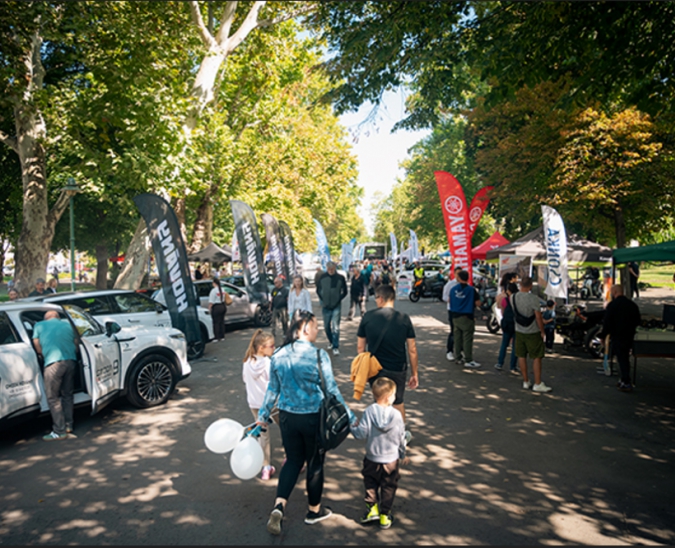
During the event’s panel discussions, university researchers, engineers, climate scientists, sociologists, and industry representatives examined the current state of e-mobility. Although questions remain regarding the production and market price of electric cars, the experts’ conclusion is clear: there is currently no better alternative for reducing air and noise pollution. This is also demonstrated by international examples, such as Norway and major Chinese cities, where the transition has visibly improved the quality of urban life.
Participants in the discussion: Boglárka Berki, lecturer at the University of Szeged’s Faculty of Engineering; Tamás Gál, head of the Department of Atmospheric and Spatial Sciences at the University of Szeged; Pál Győrfi, former spokesperson for the Hungarian Meteorological Service; Dénes Mátyás, deputy director for sustainability at the University of Szeged; László Iváncsó, Secretary General of the Future Mobility Alliance; Ibolya Ördög, a marketing specialist at Hyundai; Tibor Ajtay, a physicist at the University of Szeged; and Szabolcs Prónay, an economist at the University of Szeged.
Although the electrification of the vehicle fleet is crucial, micromobility is one of the most important areas of sustainability efforts. As László Iváncsó, Secretary General of the Future Mobility Alliance, emphasized, the use of e-scooters and bicycles is rapidly spreading throughout Europe.
The effective integration of micromobility devices into the urban landscape, the development of appropriate infrastructure, and well-thought-out traffic regulations would not only contribute to cleaner air but could also significantly reduce rush-hour traffic and traffic jams in major cities.
Szeged is already a leader in this area: In his opening remarks, Deputy Mayor Sándor Nagy pointed out that, among Hungary’s major cities, Szeged has the highest proportion of electric vehicles in public transportation, and relative to its size, Szeged has the longest network of bike paths.