
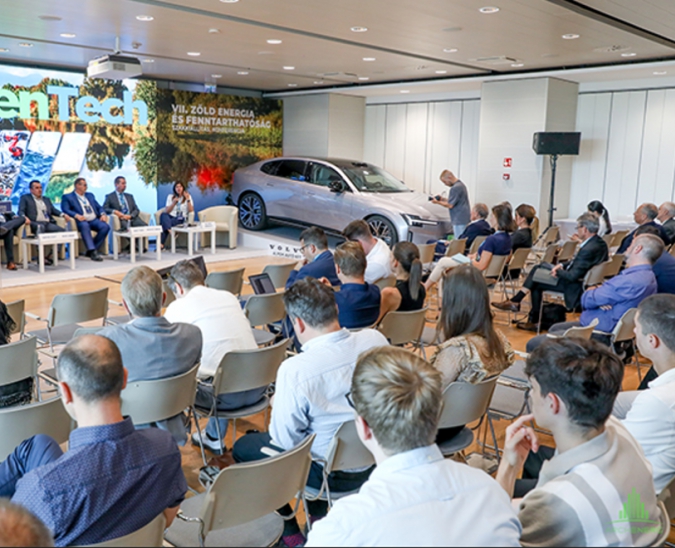
For several years now, the end of May has officially belonged to the GreenTech festival in the life of the Archenerg-Metal Cluster. The conference, organized with its traditionally high standards, made one thing clear: the question of energy supply now extends far beyond classic technical, economic, or strictly environmental frameworks. Due to the geopolitical realignments of our time and the volatility of global markets, maintaining a stable energy system has become a paramount issue of national security and competitiveness. The member companies and partners of the Archenerg-Metal Cluster develop their solutions day by day in reflection of these very challenges.
One of the most important and frequently quoted takeaways of the conference was:
"In energy supply, physics always wins in the end."
The tasks facing the energy sector cannot be approached through political slogans or ideological simplifications. Modern economies, manufacturing capacities, and heavy industry—the servicing of which is one of our cluster's main profiles—can only maintain their European and global positions with predictable, large-scale, and continuously available electricity generation.
Although innovative technologies, digitalization, and the integration of artificial intelligence (AI) are gaining value exponentially in distribution network management, baseload power plant capacities remain indispensable. Balancing winter and summer peak periods, as well as day and night cycles, requires a complex approach in which renewable and nuclear energy coexist and support each other.
A return to technical and physical realities has begun in Europe. The energy crises of recent years have clearly shown that sustainability cannot be subordinated to security and economic survival; the two must function in symbiosis.
Although rarely heard in the mainstream media, the consensus among experts is clear (available here from 4 hours and 24 minutes): Hungary's current energy policy aims to develop a highly healthy and balanced energy mix, which could serve as a progressive model to follow on an international level.
The backbone of the domestic strategy is a complex approach in which different technologies create balance by supporting one another. One of the most spectacular pillars of this is the expansion of renewable energy sources, specifically solar power capacities, the rapid domestic growth of which has been a true success story in recent years. However, alongside clean but weather-dependent sources, maintaining reliable nuclear capacity is essential for system stability. The ongoing lifetime extension of the Paks Nuclear Power Plant guarantees cheap and secure baseload energy in the long term. In parallel, the Paks II project—the construction of the new nuclear power plant units—is a crucial step toward long-term self-sufficiency. Furthermore, this project is recognized by the European Commission and, according to calculations, will generate significant profit for the Hungarian state.
However, the energy system of the future is about flexibility as well as generation. To ensure grid security, it is essential to increase system flexibility. This is jointly provided by energy storage projects, continuous grid developments, and the construction of new, fast-starting gas-fired power plant capacities, effectively supporting the integration of renewable energy sources. Finally, following new directions in technological development, the installation of smaller, flexible nuclear units—so-called Small Modular Reactors (SMRs)—at additional sites will absolutely be necessary in the medium term, making the domestic supply even more flexible and secure.
The participants of the Zalaegerszeg roundtable discussion also illustrated the challenges facing the domestic grid with concrete market data. During the event, during the daytime peak period, the Hungarian electricity system operated with approximately 2,500 MW of exports due to massive solar overproduction, while the electricity price on the exchange was around 0 EUR/MWh.
However, this situation changes drastically as soon as the sun goes down. In the evening hours (around 8–9 PM), when photovoltaic generation drops to zero, Hungary's import requirement immediately surges, reaching 2,500 MW—a volume that already exceeds the total planned installed capacity of the future Paks II Nuclear Power Plant.
The above data clearly prove that in the long term, neither security of supply, the population's quality of life, nor the competitive electricity prices necessary for industrial survival can be guaranteed in our country without stable nuclear energy.
The Archenerg-Metal Cluster is committed to ensuring that communication between professional decision-makers and society remains clear, fact-based, and professionally accurate. The future of energy supply goes beyond momentary market interests; it demands long-term investment strategies, such as those demonstrated by the exhibitors and roundtable participants at GreenTech.
As suppliers to the metalworking, machine manufacturing, and energy sectors, our cluster's member companies stand ready to provide the technological background for grid developments, planned energy investments, and the maintenance of domestic nuclear capacities. The forum in Zalaegerszeg has reinforced our conviction that combining innovation with engineering realities is the only viable path toward future economic stability.