
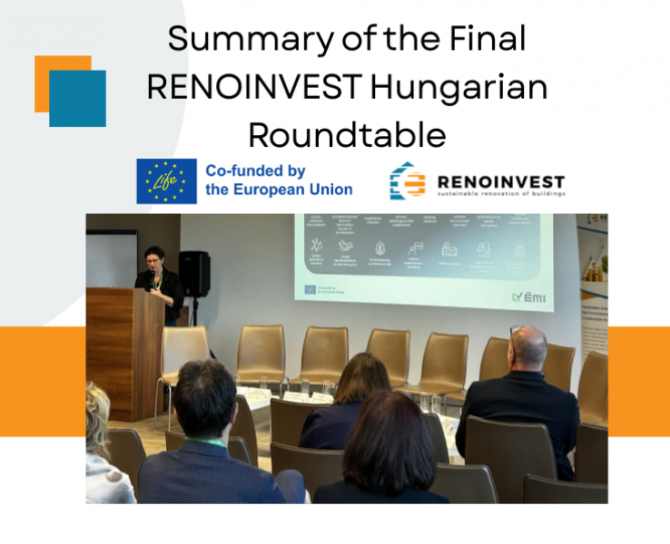
Final Hungarian National RENOINVEST Roundtable
Organised jointly by ÉMI and the Archenerg Cluster, the final Hungarian national roundtable of the RENOINVEST project focused on improving the financing and regulatory conditions for condominium and municipal building renovations, as well as strengthening the capacities that support practical implementation. The event had a dual purpose: on the one hand, to provide an overview of the project’s results to date; on the other, to open a shared professional space where market and policy stakeholders could discuss the RENOINVEST package of proposals, which addresses the main challenges of the Hungarian renovation system.
In her opening remarks, Renáta Lesti-Hermann, Head of Office at ÉMI, emphasised that promoting building renovation is not merely a technical issue: economic, institutional and cooperation-related conditions are just as important, and without them technological solutions cannot have real impact. This framework was completed by project manager Dorottya Hujber’s overview, which presented how RENOINVEST does not think in terms of a one-off programme logic, but seeks to shape a comprehensive package of proposals – an Action Plan – based on international best practices and domestic professional dialogue. This Action Plan aims to strengthen both the market viability and institutional embedding of sustainable, “smart” renovation financing.
Intersection of policy goals and financing realities
The policy framework of the event was presented by Barbara Réthelyi, Head of Department at the Ministry of Energy. In her presentation she clearly focused on the intersection of goals and financing realities: a meaningful increase in the renovation rate is only realistic if the regulatory environment, predictable support and loan products, and the readiness of the market all strengthen at the same time. She highlighted that policy intends to achieve a higher share of residential renovations through reinforcing the energy efficiency obligation scheme (EKR), enabling the modernisation of up to 120–150,000 residential properties by 2027, and extending the EKR obligation period until 2035. In parallel, the National Building Renovation Plan (NÉT) has been launched, aiming to provide a comprehensive, long-term framework for renovations.
Her message aligned clearly with the logic of the RENOINVEST Action Plan: wave-like, one-off programmes alone do not lead to stable investment decisions. Stakeholders move when the long-term trajectory is transparent and when trust and bankability for complex renovations can be supported institutionally as well.
Condominium renovation: Action Plan proposals and the first thematic roundtable
The condominium renovation Action Plan proposals developed by RENOINVEST experts were presented by Ildikó Rajné Adamecz, financial expert of the Archenerg Cluster. Her presentation provided a clear framework for the first thematic roundtable and revealed deeper, systemic causes behind the problems that need to be solved. The package identified three interlinked pillars:
-
the legal modernisation of condominium operation and financial management;
-
the creation of a financing environment that is accessible in the long term and based on financially sound, well-prepared projects;
-
and the strengthening of independent professional knowledge sharing and awareness-raising.
The first thematic roundtable examined the legal, financial and organisational barriers to renovating multi-apartment residential buildings – condominiums and housing cooperatives – and the realistic solution proposals offered by the RENOINVEST Action Plan. The aim of the panel discussion was to give as broad a professional community as possible the chance to voice its views on the Action Plan. As such, the condominium management profession, the construction economy and contractor side, banking and housing savings finance, energy communities, as well as the civil and climate policy sectors were all represented. Participants included: Dr. Róbert Gyárfás (TTOE), Réka Hámori (Hungarian Banking Association), Ilona Illésné Szécsi (MEHI), László Koji (ÉVOSZ), Mónika Kurucz (K&H Group), Edit Torda (Fundamenta-Lakáskassza), Szilvia Szilber (MITOE; Szilber Házak), Péter Nagy (Energy Control Kft.; BPMK), independent expert Gyula Szalai, and Barbara Réthelyi (Ministry of Energy). The discussion was moderated by Ildikó Rajné Adamecz.
A key common denominator in the contributions was that the condominium sector manages a significant share of national assets, yet in many cases it has been placed in a position of responsibility “without capitalisation”, where the current legal and financial framework does not provide a sufficiently stable background. This historical legacy is still visible today in weak reserve formation and short-term decision-making, whereas phased or deep renovations would require consistent planning, owner commitment and financial discipline.
The roundtable confirmed the recommendation that without modernising condominium regulation no real breakthrough can be expected. Mandatory records, stricter enforcement of maintenance obligations and a professionally grounded minimum level for renovation funds are among the preconditions for large-scale bankability. Current levels of reserve formation often do not generate real own contribution even for the preparation of larger projects, which directly undermines borrowing capacity.
From a financing perspective, the panel confirmed that green and condominium-specific products are available, but their widespread use is hindered by the lack of own contribution, fragmented general assembly decision-making and limitations in long-term predictability. Several participants noted that the dominance of variable rates and the relatively short duration of interest subsidies do not always align with today’s cost levels and the payback logic of deep renovations. This also gave rise to calls for a nationwide condominium renovation programme that could bring together owner equity, bank resources and state incentives into a long-term, blended co-financing framework to kick-start well-prepared projects at scale.
The role of the energy efficiency obligation scheme (EKR) received particular emphasis. EKR requires energy traders to implement energy-saving measures, encouraging reduced consumption and verified savings. According to participants, this is an effective mechanism and can significantly improve financial returns for certain interventions; however, because of its ex-post settlement nature, it cannot reduce high upfront financing needs. The roundtable therefore considered it essential that condominiums receive brand-independent, accessible and transparent information on which types of interventions can realistically be supported through EKR.
One of the strongest practical messages of the condominium block concerned the need for independent, “one-stop-shop” advisory and project preparation capacities. According to participants, in many cases the main barrier is not the lack of technology or financing opportunities, but the absence of reliable, institutionalised, comprehensive professional support that can guide property owners through the entire process – from defining the technical scope through aligning grant and loan opportunities to supervising implementation. International examples – including the Vilnius model and the Austrian renovation coach concept – reinforced the view that a brand-independent advisory network with municipal or state backing could significantly improve project quality and community trust, and thereby increase willingness to renovate.
European Energy Efficiency Financing Coalition – Hungarian HUB: expanding the financing ecosystem
In his presentation, László Bihari, Chair of the Hungarian HUB of the European Energy Efficiency Financing Coalition (EEFC), underlined that the investment needs required to meet national and EU climate and energy efficiency targets far exceed the available public resources. Therefore, mobilising private capital and ensuring active engagement of the financial sector are indispensable. He stressed that only standardised project development, financially well-prepared and assessable project portfolios, and the coordinated use of risk-mitigation tools can make the renovation market workable and attractive in the long term. The expert platform of the Hungarian HUB is open to new members who wish to jointly develop proposals to improve the domestic regulatory environment and remove financing barriers.
Municipal building renovation: Action Plan proposals and the second thematic roundtable
The afternoon session began with a presentation of the RENOINVEST Action Plan proposals for municipal building renovation, followed by the second thematic roundtable, which sought to answer why the energy efficiency renewal of public buildings is progressing slowly and under what conditions a meaningful renovation wave could start. The discussion brought together financial, policy, development policy, technical and municipal asset management perspectives.
Panel participants included Keve Kund Bándi (Erste Asset Management), László Bihari (EEFC Hungarian HUB), Réka Hámori (Hungarian Banking Association), László Badics (MBH Bank), Szabolcs Pusztai (National Development Centre – TOP Plusz), Barbara Réthelyi (Ministry of Energy), János Soltész (Budavár Urban Development and Asset Management Ltd.) and Dr. Krisztián Tas (Hungarian Association for Urban Development). The moderator was again Ildikó Rajné Adamecz.
One of the most important shared conclusions of the roundtable was that the limited progress in municipal renovations cannot be explained solely by a “lack of programmes”. The short-term perspective of the annual, task-based financing logic in place since 2011 is hard to reconcile with long-term, performance-based modernisation efforts, a tension that becomes especially evident in the case of ESCO/EPC-type solutions. These are energy efficiency investment models in which a specialised service provider (ESCO) designs, pre-finances and implements energy-saving improvements, while the client repays the investment costs from future energy savings. According to the participants, meaningful market development requires that the legal and institutional environment provide a predictable, transparent framework for multi-year commitments and that ESCO/EPC structures should not appear as exceptions, but as a regulated, viable “mainstream” option.
From a practical financing perspective, VAT issues also received special attention. Panellists pointed out that when the municipality is the direct investor, limited opportunities to reclaim VAT worsen project returns, whereas involving private actors can lead to more favourable structures. Bank representatives confirmed that the key to bankability is stable, verifiable cash flow and a long-term, clearly structured risk-sharing framework. At the same time, it was noted that financing ESCO companies remains expensive, which in itself can slow down market expansion.
The professional backbone of the second roundtable was the Energy Efficiency First principle. Participants agreed that too often projects start at the “end of the chain” – boiler replacement, renewables, visible technologies – while the most reliable and cheapest savings often stem from analysing operational practices, strengthening measurement and monitoring, and improving the building envelope. Poor technical sequencing can result in low-efficiency or even counterproductive investments, which undermine trust in the renovation market both energetically and financially.
The problem of data gaps also emerged as a strong message. Fragmented data on consumption, renovations and actual savings makes it difficult to build standardised, financeable project pipelines not only at local but also at national level. Experiences from small municipalities highlighted that although obligations and systems exist, many local governments lack the financial and professional capacity to turn these into real decision-support platforms. At the same time, the more optimistic professional view in the discussion was that aligning state, utility and statistical data with modern analytical methods could provide a much clearer picture of the actual national building stock more quickly, creating a solid basis for standardised project preparation and for strengthening bankability – provided a comprehensive solution is found for the coordinated, modern-method-based management and accessibility of currently fragmented data and information.
The panel also addressed the differing situations of various settlement types. Small municipalities, large cities and local governments operating in historic or World Heritage settings face distinct technical, permitting and cost risks, which calls for differentiated solution frameworks. Linking back to the morning’s condominium topics, it was also mentioned that some municipalities still appear as indirect actors in the condominium system due to residual municipal ownership shares (e.g. air-raid shelter basements, flat roofs, etc.), which are often invisible but represent real and continuous financial burdens.
The roundtable concluded that the renovation of public buildings can only be accelerated significantly if long-term performance contracts are given clear legal frameworks, if measurement and data integration become the fundamentals of planning and monitoring, and if a mixed financing and partnership environment emerges in which the state, banks, the ESCO market, municipalities and local communities can jointly implement flagship projects and develop scalable models.
Summary
In the end, the two thematic panels of the final national roundtable arrived at the same strategic insight: while the renovation logics of the residential and public sectors differ, the conditions for large-scale investments that deliver substantial energy savings are essentially the same. Without a modern and predictable legal environment, trust among market actors and municipalities will not strengthen; without long-term, combinable financing instruments, investment decisions will not be made; and without adequate, independent advisory and project preparation capacities, programmes cannot turn into transparently prepared, well-founded renovation projects.
The message of the event therefore went far beyond a single project milestone: the substantial acceleration of condominium and municipal renovations does not depend on one isolated measure, but on the coordinated renewal of legal, financial and knowledge-sharing frameworks. The technical and financial solutions are fundamentally available; the real question is whether a stable, transparent and cooperation-based framework will emerge in which these solutions can become widespread, long-lasting and high-quality practice. RENOINVEST partners will continue working to translate the proposed measures into concrete, implementable actions and thereby contribute to the creation of a more predictable and effective renovation environment.
The presentations delivered at the event and the event programme can be viewed at the link below:
-
Ildikó Rajné Adamecz_RENOINVEST Municipal Recommendations_2025.11.27
-
Ildikó Rajné Adamecz_RENOINVEST Condominium Recommendations_2025.11.27
-
Barbara Réthelyi_EKR, NÉT and Building Renovation Programmes (Ministry of Energy)_2025.11.27
